Transcript
Download Transcript
Ryan Neal: Welcome back to the podcast. We're coming to you from the conference hall floor here at Synergy 26 in Washington, DC. I'm flying solo. Bill Coppel, my co-host, is on assignment, but we're bringing in one of our local D.C. guys here. He is the Senior Vice President, General Counsel and Corporate Secretary at Robinhood, Mr. Lucas Moskowitz. Lucas, thanks for joining me.
Lucas Moskowitz: Yeah, thanks for having me.
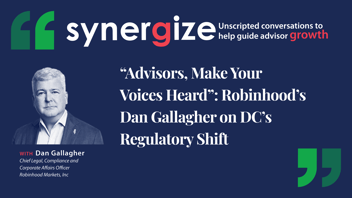
Ryan Neal: So we have at Robinhood an impressive, to say the least, lineup of regulator folks and lawyers — everything in your career. I'm just going to read it off here. You worked at a major big law firm, went to the SEC, worked on Capitol Hill, and now you've rejoined your old boss, Mr. Dan Gallagher, who also came on the podcast with us at Robinhood. So I'm just curious about, you know, learning from your experience. What can you tell the financial advice audience about what they need to know in terms of the regulatory environment?
Lucas Moskowitz: So you mentioned I used to work for Dan. I work for him now. I've had the privilege of working with some great folks over the years, some great mentors — Dan being one of them, Jay Clayton, who is former SEC chairman, and a number of others. Too many to list. But, you know, you learn a lot from those folks about not only how to practice law, but they're very pragmatic people, problem solvers, markets people. They understand how markets work. And I've tried to learn from that and bring that into these various roles. I had the good fortune of spending a number of years on the Hill, at the SEC, and then of course in private practice, and now at a very innovative company, Robinhood.
Lucas Moskowitz: And so there's a lot going on all the time. And now it's a little bit more on the front foot — more innovation, more growth than there was in years past with the change of administration, which is very exciting. But of course, all of that brings with it regulatory and legal considerations, which we are hard at work on every day. The regulators are, I think, very amenable to having these conversations now and figuring out, hey, what's the path forward on all of these big issues? We're talking about crypto, prediction markets, AI. And so again, very exciting time. There's lots happening on the regulatory front here in DC. Hopefully we'll start to see some movement on some big initiatives they want to get done soon.
Ryan Neal: What can you tell us about how that has helped shape your perspective around guardrails that protect investors versus allowing that innovation — and balancing those things? How has your perspective been shaped through your career?
Lucas Moskowitz: It's a great question. And the way you put it, it's balance, right. You have to balance having the right safeguards in place, but also innovating, giving customers more choice, more access. That's what this country is all about. That's what we're all about at Robinhood. And I had the good fortune of seeing it on both sides. I sat in the enforcement division at the SEC, working for Commissioner Dan, working for the chairman, and seeing some really good stuff and some really bad stuff. And so that gives you a real appreciation. There are a lot of bad actors out there, and there always will be. And it's unfortunate that capital markets are inherently, in some sense, risky. And so you see that and you've got to carry that over when you come into the private sector and you're trying to grow and innovate — again, trying to provide access and choice.
So how do you balance that? That's what we do every day at Robinhood. And it's not mutually exclusive by any stretch. There are quite complementary goals. We can have the protections and guardrails in place both at the regulatory level and in the products we offer at Robinhood, but also have them be groundbreaking products that get more people into the market, that save people money, that get people participating more. That is the foundation of what the SEC's mission is. And our mission — to the SEC — is a mission to protect investors. But it's also part of that mission: fair and orderly and efficient markets and capital formation, just like ours is to give customers access and choice, but have a safety-first or safety-always approach to it.
Ryan Neal: So with TradePMR coming aboard — a whole new world of wealth advisors — what can you share with them right now? What's on your mind? What do you think are some of the biggest trends that are impacting advisors right now?
Lucas Moskowitz: Yeah, so it's super exciting to have TradePMR on board with us. It's a massive need in the market across all kinds of segments — to have these various different offerings and different products and advisories. Hugely important. I, of course, spent many years in and out of government working on advisory type issues. And so it's very familiar territory.
Look, one of the biggest things now — and we don't have enough time to go through all of the different things that I'm sure advisors are focusing on, excited about, and worried about — but AI is a huge one. We've got a lot of different players in the AI space. You've got some that are regulated, some that are not regulated. The kind of offerings in the financial space are starting to merge together for regulated platforms. And so what's the future of AI in financial advice? I think it's going to be a very, very interesting topic and business opportunity over the next several years. I'm not sure exactly how it's going to play out. But I think there's a tremendous opportunity to serve customers better with AI. I don't think we're ever going to lose the human element, and I don't think we should. But how do we provide even better products and services to customers using technology that's core to what we do? That's going to be a big opportunity.
Ryan Neal: So another thing that you've talked about a lot in your career is modifying the accredited investor regulations. And we had a big announcement yesterday at our conference around bringing IPO access for advisors to our platform. Can you talk about the changing environment for IPOs — what it's doing to the market, allowing more retail investors and financial advisors to participate?
Lucas Moskowitz: I know our compliance folks over here might get nervous. We'll keep it on the top level. But the backstory here is you have fewer public companies now than you had 20 years ago. Significantly fewer. Companies are staying private longer. And of course, there are regulatory restrictions in place. The accredited investor definition is the big one that prevents the vast majority of retail customers from participating in private markets, where a lot of growth is happening. That's just a fairness issue. That's an issue for the economy. That's an issue for the end investor too.
And so this goes back to your question about how do you balance access and innovation and protection. This is a key example of that. How do we let more retail into the market but continue to have the right guardrails around that participation so that people can do it as safely as possible? We've been talking to regulators and policymakers about this consistently now for a while. It's really ramped up recently. And we're going in and proposing a number of different solutions on how to do this as safely as possible. Because it's a big gap in the market right now and it's got to be fixed. And we're doing it as well with market-driven solutions. But we also want to attack this from a regulatory standpoint — are our rules right now fit for the current age? Are they fair? Do they make sense with the retail participants these days? Can we allow more access and participation, give people the opportunity to participate in these growth stories, while having the right rules in place?
Ryan Neal: Yeah, it makes sense. Well, look, thank you so much for joining us. We like to leave our audience with one piece of advice they can take back to their practice. What's one thing that you really want financial advisors to know and take home with them?
Lucas Moskowitz: I would say: pay attention to what's happening here in Washington. It's become, for better or worse, maybe one of, if not the biggest financial capitals in the world right now — because of the importance of the regulatory environment. There's a lot happening every day and it's developing really quickly. And if you don't pay attention to that stuff, you're really missing out on where the future of all this is going. Because, again, for better or worse, DC plays a big role in markets now.
Ryan Neal: All right. Well, you heard it — pay attention to DC. Lucas, thank you so much for taking the time to join the podcast and go crush it up on the Synergy stage. We appreciate you being here.
Lucas Moskowitz: I appreciate it. Thank you.
OUTRO:
If you want to join the conversation or connect with us, please visit us at synergizepodcast.com. This content is provided for general information purposes only. The views expressed by non-affiliated guest speakers are their own and do not necessarily reflect the opinion of TradePMR or its affiliates. TradePMR and its affiliates do not endorse any guest speakers or their companies and therefore give no assurances as to the quality of their products and services. This channel is not monitored by TradePMR. TradePMR does not provide investment advice, tax advice or legal advice. TradePMR is a member of FINRA and SIPC. TradePMR, Inc. is registered with the Securities and Exchange Commission (SEC) and the Municipal Securities Rulemaking Board (MSRB). TradePMR provides brokerage and account services to registered investment advisors. Custodial services provided by First Clearing. First Clearing is a trade name used by Wells Fargo Clearing Services, LLC, Member SIPC, a registered broker dealer and non-bank affiliate of Wells Fargo & Company. Copyright 2026. TradePMR, Inc. TradePMR, Inc. is a subsidiary of Robinhood Markets, Inc.As a reminder, today's podcast will contain forward-looking statements. Actual results could differ materially from our expectations. Except as required by law, we assume no obligation to update any of the statements in this podcast whether as a result of any new information, future events, changed circumstances, or otherwise. Potential risk factors that could cause differences including regulatory developments that we continue to monitor are described in our SEC filing.